The central curve
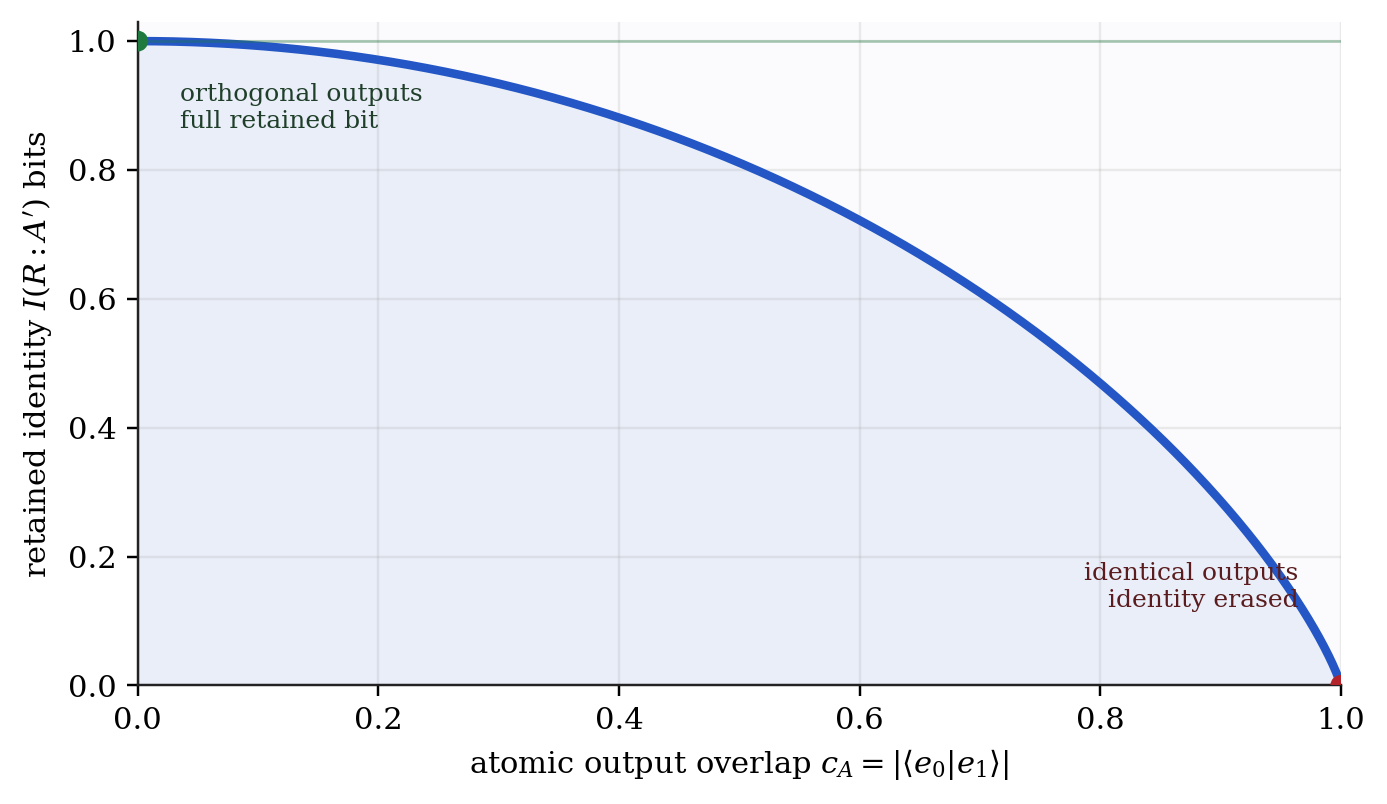
Identity retained by the atom falls as the final atomic states become harder to distinguish.
Paper idea
The paper asks a localization question
A photon is absorbed by an atom. Its energy becomes atomic excitation,
with only a tiny recoil correction. But the photon's identity means
something different: which photon alternative was absorbed?
The paper tracks that identity with a reference system \(R\). The full
output \(A'D\) can still preserve the reference correlation. The atom
\(A'\) alone may not.
\[
A\gamma \longrightarrow A'D
\]
\(A'\) is the final atom. \(D\) is everything not inspected: recoil,
motional modes, fields, environment, or other records.
The point of writing the process this way is to keep the missing
degrees of freedom visible. If identity is not found in the atom, the
framework asks whether it moved into \(D\), rather than treating it as
simply destroyed.
Translation key
Symbols in plain language
Paper symbols
\(R\)
Reference labeling the photon alternatives.
\(I(R{:}S)\)
Reference bits recoverable from system \(S\).
\(A\gamma\)
Initial atom plus incoming photon.
\(A'\)
Final atom after absorption.
\(D\)
Unread recoil, motion, fields, environment, or records.
\(\rho^-,\rho^+\)
States before and after absorption.
\(\eta_{\rm abs}\)
Fraction of photon identity retained by \(A'\).
Budget and experiment symbols
\(\mathcal J_{\rm abs}\)
Identity budget before absorption.
\(\mathcal I_{\rm ret}\)
Identity retained in the atom.
\(\mathcal L_{\rm abs}\)
Identity leaked into \(D\).
\(\eta_{\rm int}\)
Eta-int: fraction retained in the internal manifold.
\(d_e\)
Dimension of the internal excited carrier.
\(d_A,d_D\)
Atom-space and discarded-space dimensions in simulations.
\(N\)
Number of possible photon labels.
Core asymmetry
Energy and identity obey the same global accounting, but not the same local behavior
Energy is almost forced into the atom. For an optical photon on
hydrogen, the recoil fraction is roughly:
\[
\frac{\hbar\omega}{2Mc^2}\sim 10^{-9}
\]
Here \(\hbar\omega\) is the photon energy, \(M\) is the atomic mass,
and \(c\) is the speed of light. The atom keeps essentially all of
the photon's energy.
Identity is measured by retained correlation with \(R\). Its
localization fraction \(\eta_{\rm abs}\), pronounced eta-abs, is:
This can range from \(0\) to \(1\). It is dynamical, not recoil-pinned.
The claim is not that mutual information is new. The claim is the contrast:
energy is locally pinned near one, while identity can localize, leak, or
disappear from the atom's accessible state.
Paper results
The two main mathematical handles
The paper builds a conserved identity budget, then studies how much of
that budget is locally readable from the atom.
1
Accounting identity
The full absorption map is reversible on \(A'D\). Globally, the
reference correlation is not destroyed.
The atom keeps \(\mathcal I_{\rm ret}\). The rest lives in \(D\).
This is the bookkeeping version of conservation: identity is not
erased by the full map, but it may leave the subsystem we actually
measure.
That is why the paper separates retained identity from leaked
identity. The total is the stable object; the split tells us what an
atom-only observer can actually recover.
2
Two-state curve
For two possible photon labels, the atom's retained identity depends
only on the overlap of the two final atomic states.
Here \(|e_0\rangle\) and \(|e_1\rangle\) are the two possible final
atomic states, \(c_A\) is their overlap, and \(h_2\) is the binary
entropy function.
Orthogonal outputs retain the bit. Identical outputs retain none of it.
This curve is the cleanest falsifiable shape in the paper: if the
overlap is swept experimentally, the retained fraction should follow
the binary-entropy curve.
3
Finite internal dimension no-go
If only an internal excited manifold of dimension \(d_e\) is read out,
it can hold at most \(\log_2 d_e\) identity bits.
The symbol \(\eta_{\rm int}\), eta-int, is the internal localization
fraction: retained internal identity divided by the starting identity
budget.
For \(N\) balanced, distinguishable photon labels,
\(\mathcal J_{\rm abs}=\log_2 N\).
The result is a no-go, not a typical-case statement. Even a perfect
internal memory cannot store more independent label bits than its
internal dimension allows.
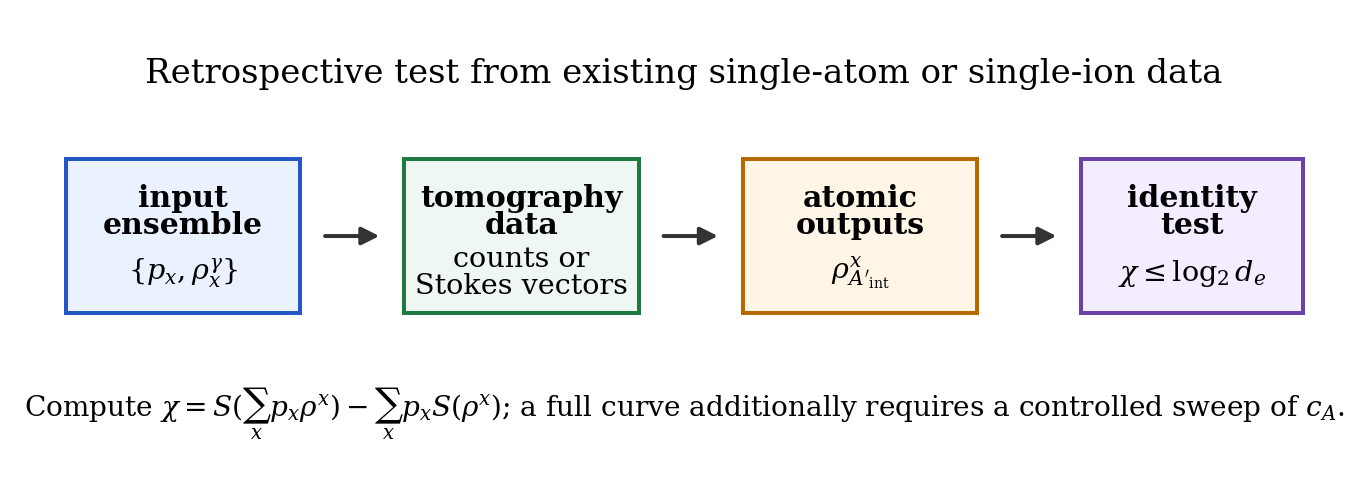
Existing tomography can check endpoints and carrier ceilings. A controlled
sweep of overlap \(c_A\) tests the functional curve.
Experiments PDF
What the numerical experiments are doing
These are simulations, not laboratory data. They make the paper's
bookkeeping visible by sending photon labels through idealized absorption
maps and measuring how much label information remains in the atom.
In this section, \(x\) is one photon label, \(|\Psi_x\rangle\) is the
final joint state created by absorbing that label, and
\(\rho_A^x\) is what the atom alone looks like after we ignore \(D\).
The operation \(\operatorname{Tr}_D\) means "trace out \(D\)," or
discard the unobserved degrees of freedom mathematically.
The readable atomic identity is the Holevo information. Here
\(S(\rho)\) is von Neumann entropy in bits, \(\chi_A\) is the number of
label bits readable from the atom, and \(\eta_A\) is the retained
fraction:
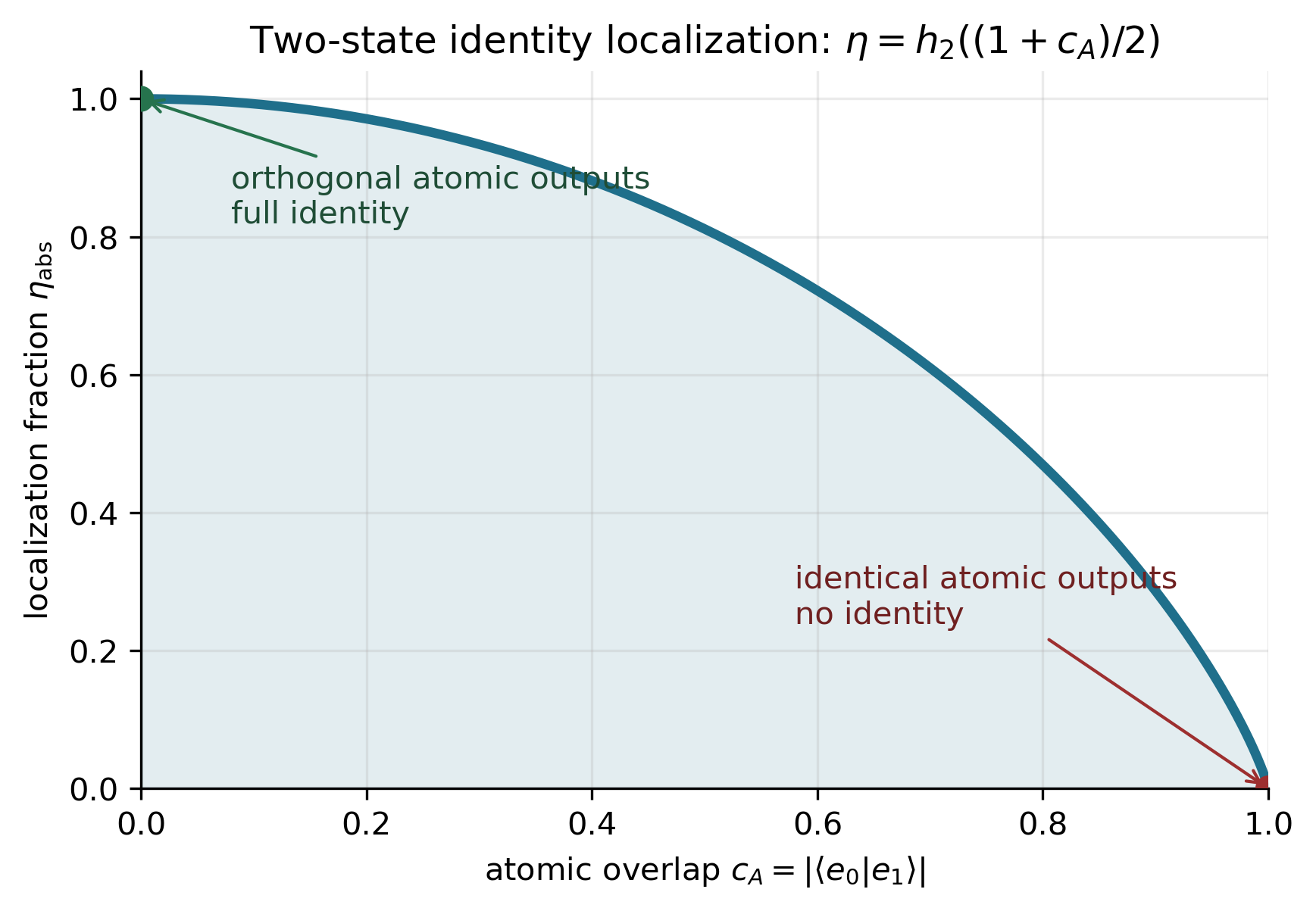
Two photon labels lead to two final atomic states. As those states
become more alike, the atom has less identity information.
The horizontal axis is the overlap between those two atomic states.
Moving right means the atom's two possible outputs are harder to
tell apart.
The vertical axis is the fraction of the original one-bit label that
remains readable from the atom. Near the left edge the atom acts like
a good record; near the right edge it has effectively forgotten
which label arrived.
This is distinguishability made visible.
Orthogonal atomic outputs retain one bit; identical outputs retain none.
Figure 2
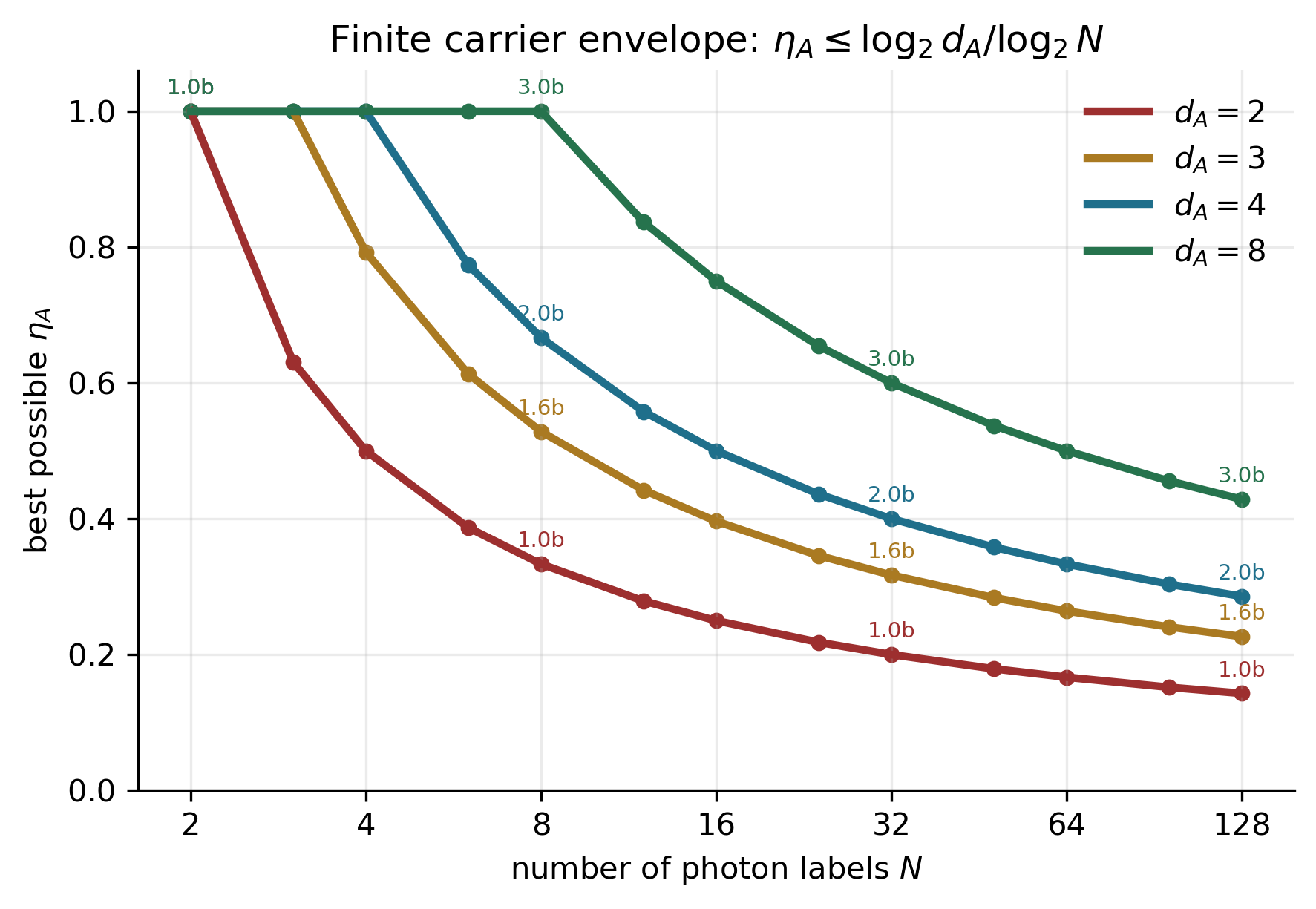
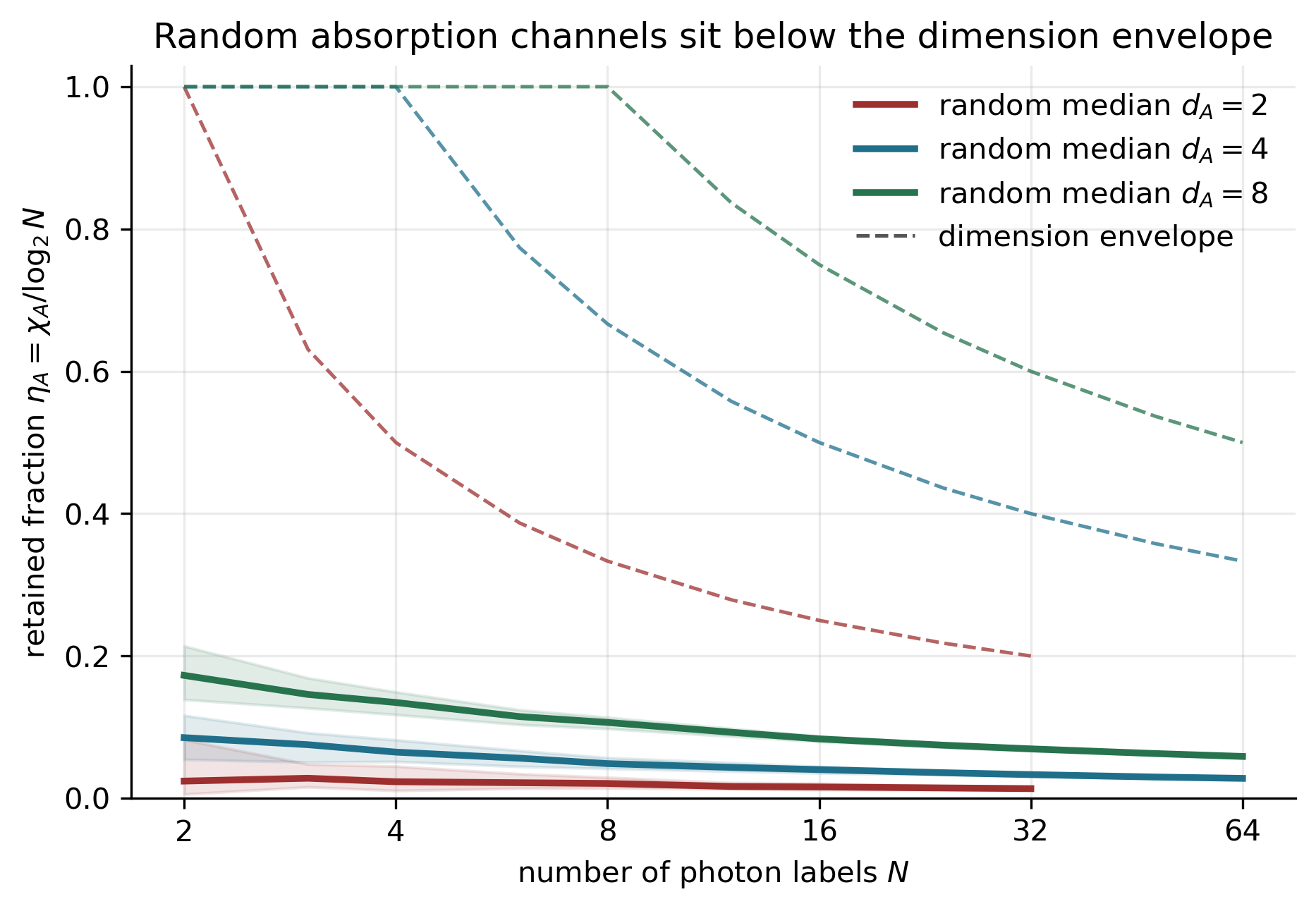
The best possible finite memory
This is the ideal capacity limit. A finite atom can store only so many
label bits internally.
Here \(d_A\) is the dimension of the atomic space used in the
simulation, and \(N\) is the number of possible photon labels.
Each curve asks a best-case question: if the atom were used as an
ideal memory, what fraction of the label could fit inside it?
If the labels do not fit, identity must be outside the atom.
The dimension envelope for an ideal internal carrier.
Figure 3
Generic absorption is worse than ideal memory
Random reversible maps usually spread the label into \(D\). The atom
retains much less than the theoretical ceiling.
Each sample is a different generic absorption map. The plot asks
what happens without carefully engineering the atom to act as a
memory.
The dashed curves show what is allowed in principle. The solid curves
show what random maps usually achieve, which is far lower.
A good memory is structured. A generic coupling is not.
Solid curves are random medians; dashed curves are dimension ceilings.
Figure 4
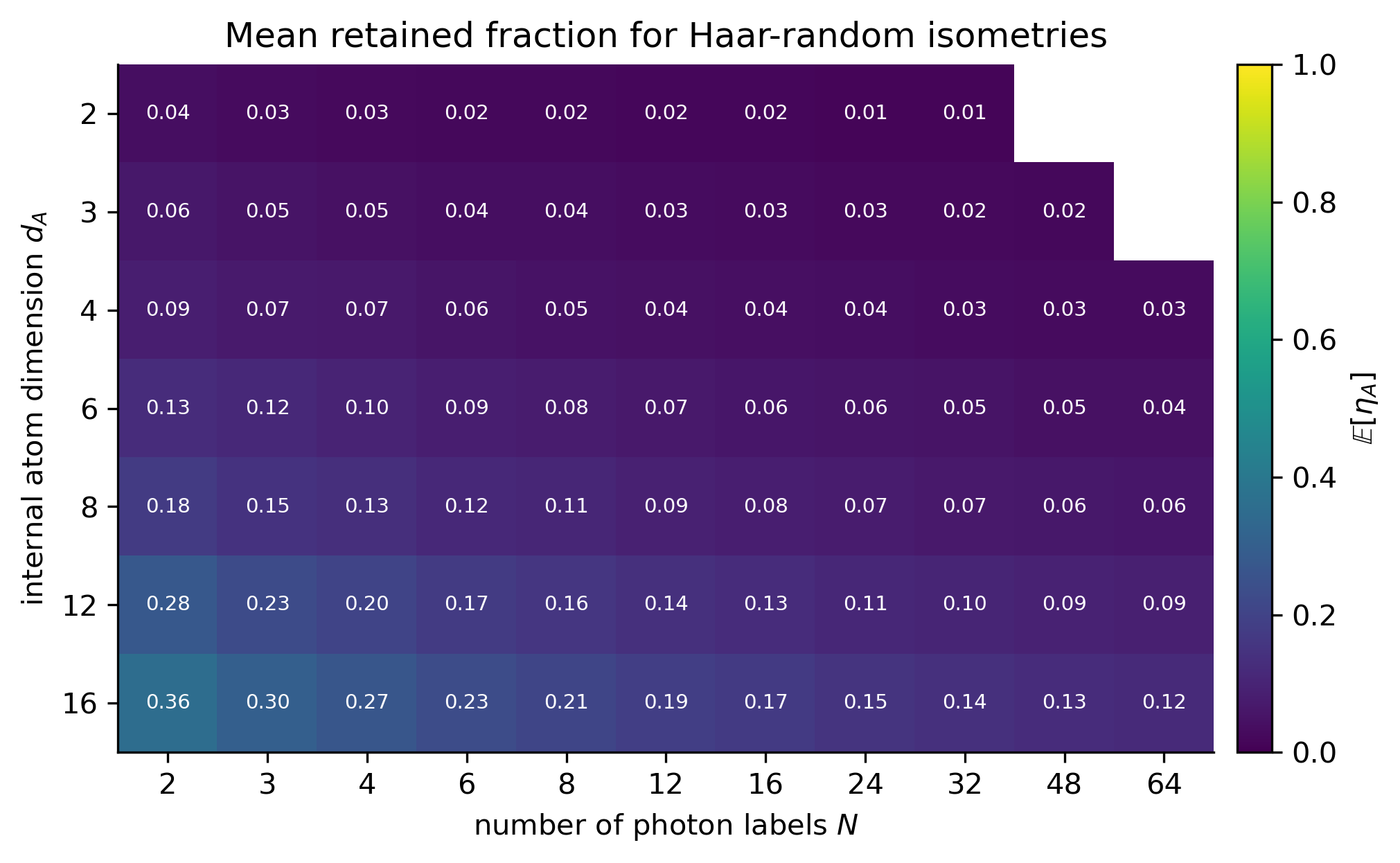
Dimension pressure
Rows vary atom dimension \(d_A\). Columns vary the number of photon
labels \(N\). Brighter cells mean more retained identity.
Read it like a map: moving downward gives the atom more room, while
moving right gives it more labels to remember.
The dark upper-right region is the hard regime: small atomic carrier,
many possible labels, and most identity outside the atom.
Bigger atoms help, but generic maps still leak most high-\(N\) identity.
A compact view of retained fraction across \(d_A\) and \(N\).
Figure 5
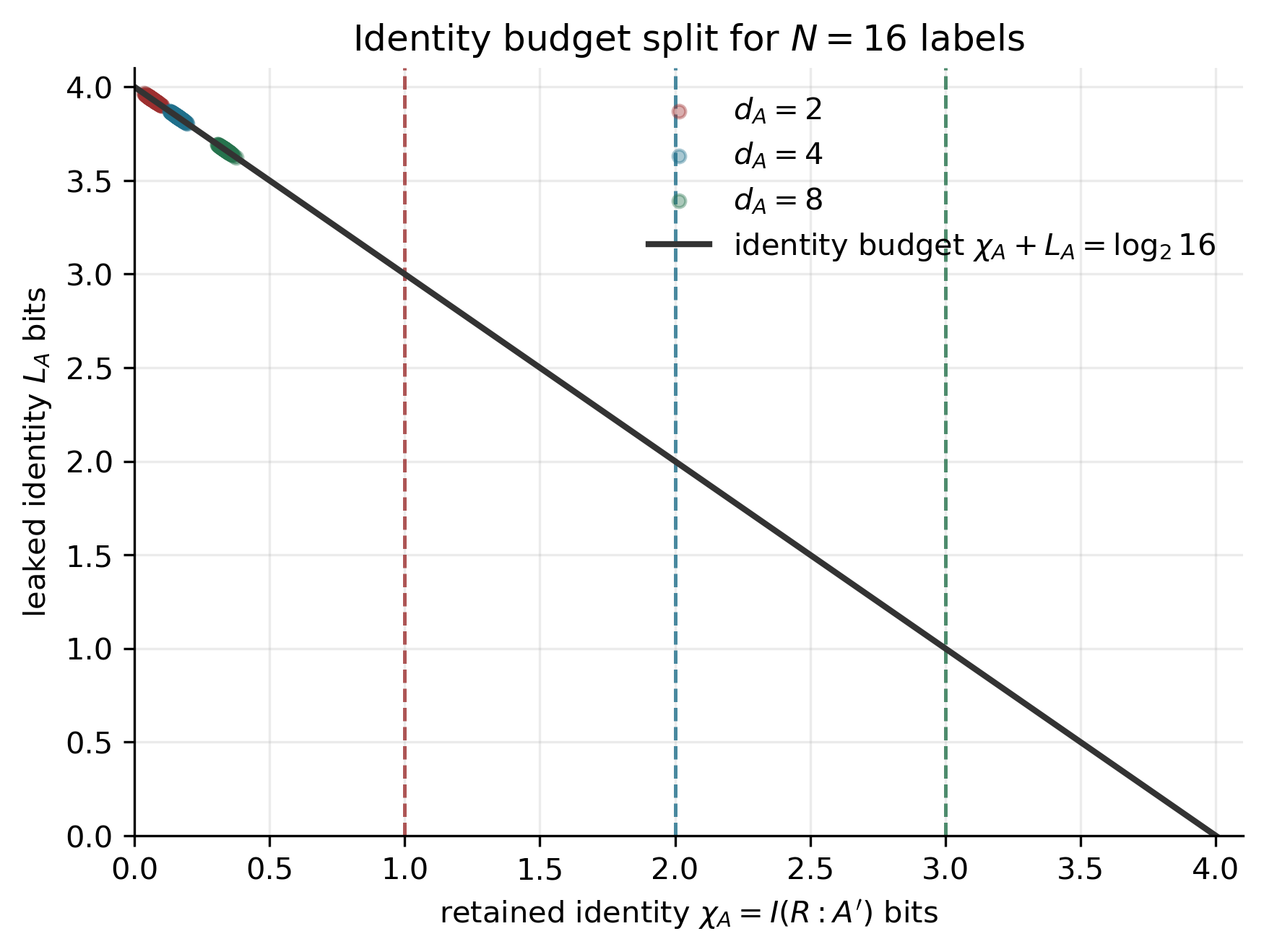
The bookkeeping line
For \(N=16\), the incoming identity budget is four bits. Each random
map splits those bits between retained identity and leakage.
Here \(L_A\) means leaked identity: the part not readable from the
atom alone.
Moving right means the atom remembers more. Moving up means more of
the same fixed budget has gone into discarded degrees of freedom.
\[
L_A=\log_2N-\chi_A
\]
Retained plus leaked identity equals the starting budget.
Every point respects the fixed identity budget.
Figure 6
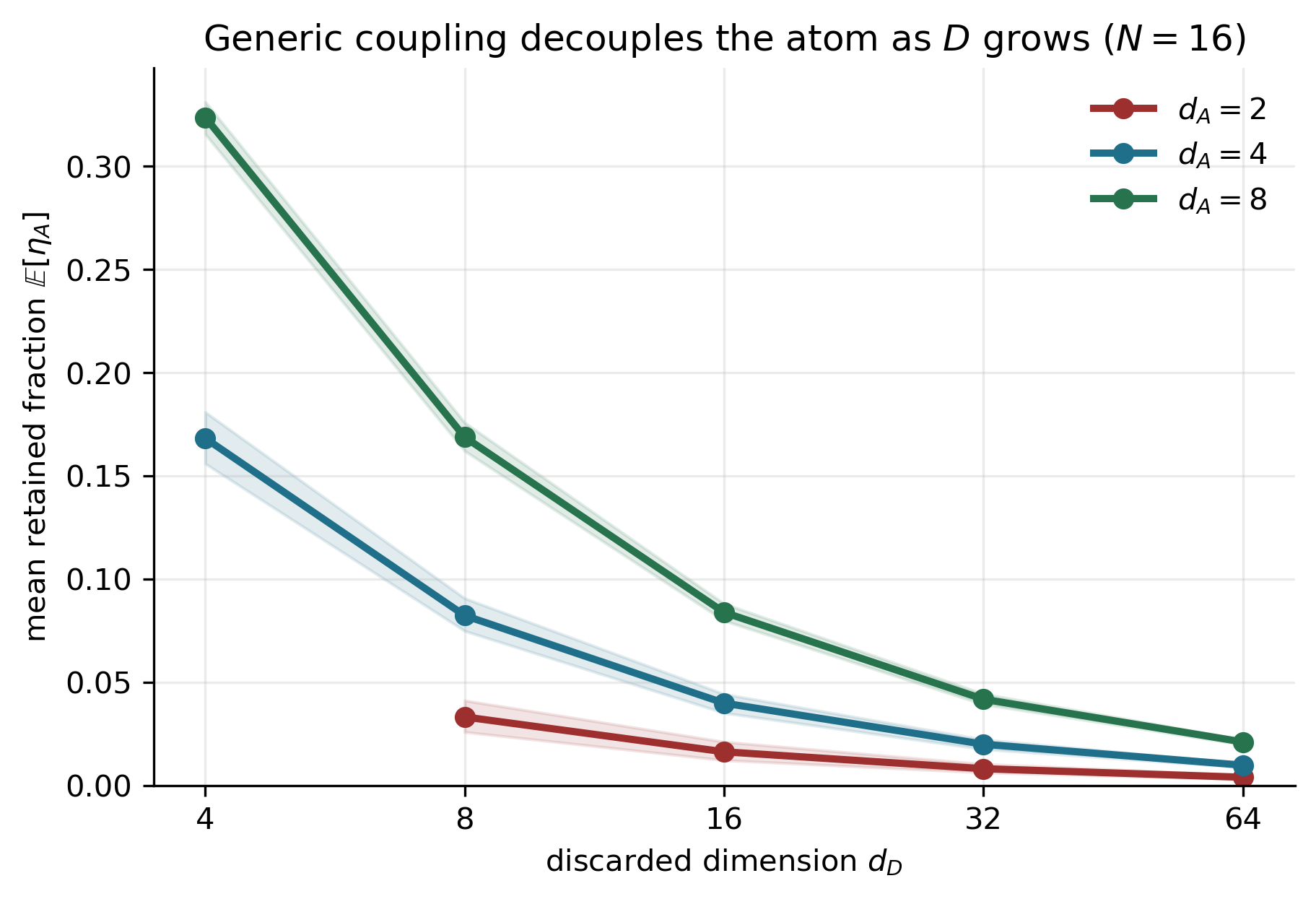
More unobserved space means less atomic memory
Holding \(N=16\) fixed, increasing \(d_D\) gives the ignored space
more room to carry the label.
Here \(d_D\) is the dimension of the discarded space \(D\).
This isolates the role of the unobserved sector. More available
hidden space makes it easier for identity to leave the atom.
The curves should be read as a generic trend, not a lab claim: once
\(D\) is larger, random maps have more room to make the atom's
reduced states look alike.
The full output still remembers; the atom alone remembers less.
Generic coupling decouples the atom as the discarded space grows.Takeaway
What the project says
The paper's thesis is the asymmetry: energy and identity both obey global
accounting across \(A'D\), but energy is pinned near the atom while
identity can be distributed.
The simulations show the geometry behind that statement. A finite atom
can absorb the photon's energy while much of the photon's label lives in
discarded degrees of freedom.
The numerical plots are explanatory simulations. They do not replace the
proposed experimental test: a controlled sweep of the atomic-state overlap
\(c_A\), plus tomography to reconstruct retained identity.